
HUF Tax Planning for Capital Gains: A Smart Strategy to Save Tax
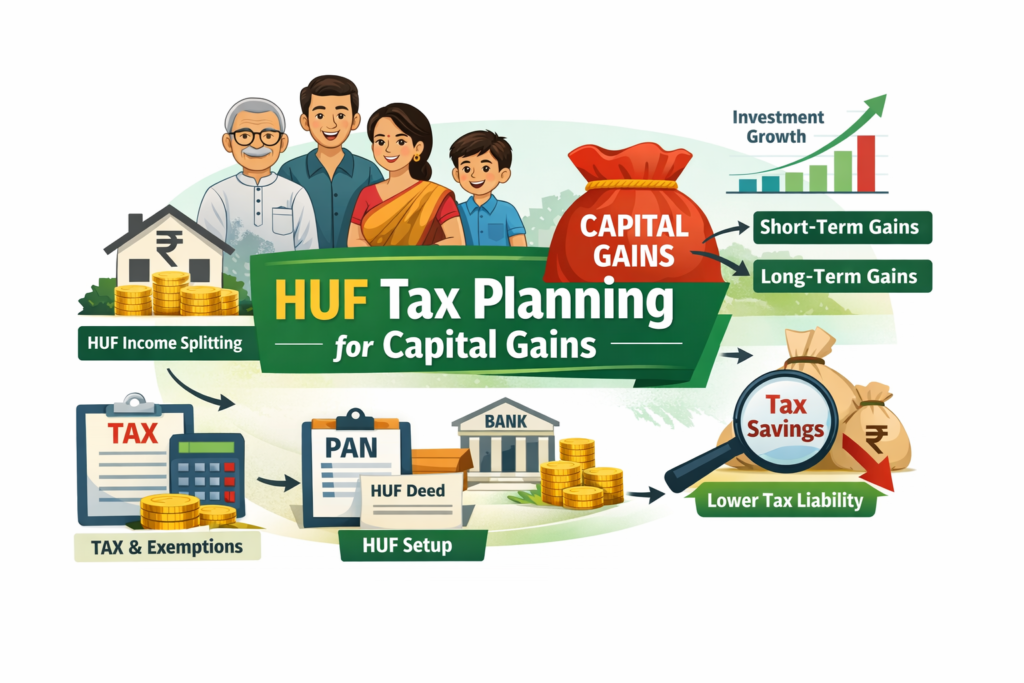
In an increasingly dynamic investment environment, tax planning is not merely about compliance-it is about structuring income efficiently. Tax efficiency plays a critical role in wealth creation. One of the most effective yet underutilized tools available for families is the Hindu Undivided Family (HUF) structure. HUF tax planning for capital gains is becoming an essential strategy especially in share market investments, HUF can significantly optimize tax liability on both short-term and long-term capital gains with the help of professional tax planning services. HUF is treated as a separate legal entity for taxation purposes, similar to an individual taxpayer.
Tax Slab Rates Applicable to Individuals and HUF
Both individuals and HUFs are taxed at the same slab rates, as HUF is treated as a separate taxable entity under the Income-tax Act.
* Up to ₹4,00,000 – Nil
* ₹4,00,001 to ₹8,00,000 – 5%
* ₹8,00,001 to ₹12,00,000 – 10%
* ₹12,00,001 to ₹16,00,000 – 15%
* ₹16,00,001 to ₹20,00,000 – 20%
* ₹20,00,001 to ₹24,00,000 – 25%
* Above ₹24,00,000 – 30%
Both individual and HUF get separate slab benefits, which is the foundation of tax planning through income splitting. HUF enjoys its own basic exemption limit i.e., Rs 4,00,000, independent of individual members.
Taxation of Capital Gains in Market
Income from equity investments is broadly categorized into:
- Short-Term Capital Gains (STCG): Applicable when listed shares are sold within 12 months. STCG on equity shares (where STT is paid) is taxed at 20% under Section 111A.
- Long-Term Capital Gains (LTCG): Applicable when shares are held for more than 12 months. LTCG exceeding ₹1.25 lakh is taxed at 12.5% under Section 112A. Gains up to ₹1.25 lakh remain exempt.
This allows individuals portion of capital gains to remain tax-free when structured appropriately, reducing the overall tax burden of the family. Equity investments held under a HUF benefit from separate exemption thresholds on long term capital gain up to Rs. 1.25 lakh is exempt, creating a HUF allows families to claim this exemption twice-once individually and once in HUF-effectively doubling tax-free gains. Strategic allocation of trades between HUF and individual accounts helps in better utilization of capital losses for set-off and carry forward. Proper HUF tax planning for capital gains ensures better income structuring.
Steps to Create HUF and Start Investment
To start investing through HUF, the following steps are essential:
1. Create HUF Deed
2. Apply for PAN of HUF
3. Open HUF Bank Account
4. Open HUF Demat & Trading Account
5. Ensure clear fund trail (no mixing with individual funds)
Professional guidance ensures compliance and proper structuring from the beginning.
Practical Illustrative
Let’s look at a practical illustrative. Suppose Mr. Raghav income for FY 25-26 is:
* Salary: ₹15,00,000
* STCG: ₹5,00,000
* LTCG: ₹7,00,000
Scenario 1: Only Individual:
Tax Treatment:
* Salary taxed as per slab (reaches highest slab) = ₹1,05,000
* STCG taxed @ 20% = ₹1,00,000
* LTCG exemption = ₹1.25 lakh
Taxable LTCG = ₹7,00,000-₹1,25,000=₹5,75,000
Tax on LTCG= ₹5.75 lakh @ 12.5% = ₹71,875
Total Capital Gain Tax = ₹1,71,875 (excluding cess)
Salary already taxed at higher slab → no further optimization
Scenario 2: Individual + HUF Structuring
Reallocation Strategy:
- Individual:
* Salary: ₹15,00,000
* STCG: ₹2,50,000
* LTCG: ₹3,50,000
- HUF:
* STCG: ₹2,50,000
* LTCG: ₹3,50,000
Tax Impact
- Individual:
STCG: ₹2.5 lakh @ 20% = ₹50,000
LTCG: ₹3.5 lakh – ₹1.25 lakh = ₹2,25,000
LTCG Tax =₹2,25,000*12.5%= ₹28,125
Individual Capital Gain Tax = ₹78,125
- HUF:
STCG: ₹2.5 lakh → falls within basic exemption (₹4 lakh) → Nil tax
LTCG: ₹3.5 lakh – ₹1.25 lakh = ₹2.25,000
(Adjusted 1.5 lakh within remaining exemption)
LTCG tax= ₹75,000*12.5%= ₹9,375
HUF Capital Gain Tax = ₹9,375
Final Comparison
| Particulars | Only Individual | Individual + HUF |
| STCG | 1,00,000 | 50,000 |
| LTCG | 71,785 | 28,125 |
| HUF TAX | – | 9,375 |
| TOTAL TAX | 1,71,875 | 87,500 |
Tax Saved = ₹84,375
Benefits of HUF Tax Planning for Capital Gains
HUF tax planning for capital gains offers multiple advantages for investors and families looking to reduce their tax burden. Since HUF is treated as a separate taxable entity, it allows individuals to split income and utilize an additional basic exemption limit.
One of the major benefits of HUF tax planning for capital gains is the ability to claim separate exemptions on long-term capital gains, effectively increasing tax-free income. This strategy becomes especially useful for individuals involved in share market investments, where both short-term and long-term gains can be structured efficiently.
Additionally, HUF tax planning for capital gains helps in better utilization of losses, allowing set-off and carry forward benefits that further reduce overall tax liability.
What We Do – Expert Guidance
We at our firm, Ashok Darshan and Co. (ADAC), we believe that effective tax planning is a combination of technical expertise and practical execution. With our taxation services in Rudrapur, we analyze client income profiles, trading patterns, and financial goals to design efficient tax-saving strategies. We after proper analysing client’s income profile, trading pattern, and financial goals, guide our clients on how to allocate long-term and short-term trades efficiently between entities to maximize tax benefits. From drafting HUF deed, obtaining PAN to assisting in designing a dual-portfolio strategy-allocating long-term investments and short-term trades between individual and HUF in a way that maximizes exemptions and minimizes tax exposure.
We at ADAC, ensure proper maintenance of records, transaction classification, and accurate filing of returns. This reduces the risk of scrutiny and ensures that all tax benefits are safely claimed. HUF, when positioned strategically, evolves from a traditional concept into a high-impact tax planning instrument and HUF structure, when integrated with share market investments, offers a powerful avenue for tax optimization. With the right professional guidance, HUF becomes not just a compliance tool, but a smart financial strategy for long-term wealth creation.
Hi, this is a comment.
To get started with moderating, editing, and deleting comments, please visit the Comments screen in the dashboard.
Commenter avatars come from Gravatar.